skip to main |
skip to sidebar
 (Columbia, 1980)This is hardly a bold opinion to toss out there, but Billy Joel’s a hack. He threw stylistic poo at the wall for a while with the Hassles and Attila, then finally hit with his solo balladeer persona, so he went and rode that for as long as he could. Nothing necessarily wrong there, fellow strivers, just saying we might as well be frank about the fact that most of his career consisted of sub-Wings rips or, to be more generous, sub-versions of McCartney’s neverending string of Big Piano Songs (“Lady Madonna,” “Hey Jude,” “Let it Be,” “Maybe I’m Amazed,” etc.). Again: In spite of the obvious hackery, nothing particularly awful about that, I reckon. So it’s with some appreciable amount of non-backhandedness that I praise “It’s Still Rock and Roll to Me” for breaking out of that mold by instead ripping off Elvis Costello for a snappy, relatively hard-edged, nasty-voiced popper that digs its heels in against new-wave fashion while, uh, sounding really new-wavey. And whatever the obvious self-contradictions present, it’s a fun song! Bitter, but FUN! Outta touch, but FUN! FUN, I say! Fuh-fuh-FUN! And FUN is what we need in these weird times, yeh? YEH!
Then there’s “Through the Long Night” on the B-side, where BillyBoy reverts to form, the track sounding as it does shockingly like something off of London Town, both musically and vocally. And yet I actually have to give the guy credit for again approximating tasteful, hyper-melodic McCartneyisms better than anyone else in the worldiverse…it is a REAL SKILL to be able to ape that rather special form so successfully. Begrudgingly I do applaud you, William Joel!
Also, I might as well mention that, for reasons we don’t need to get into, Billy Joel used to call my apartment on an irregular basis when I was a senior in college (wasn’t looking to talk to me, sadly). Think I’m japing? Nope. Strange but true, as they say.
 (Columbia, 1959)Song’s called “The Battle of New Orleans,” and that’s exactly what the thing’s all about, as Johnny Horton hickishly rasps forth the story of a certain 1815 military dust-up with the British. Novelty song? Pretty much, yeah! There’s a good-natured levity present, but military drums, banjo, and an oom-pah bass give the song an appropriately martial feel, and those deep-voiced dudes who march up to the mic in the chorus truly seal the deal: this is a novelty of the MANLY sort. Patriotic, too! AND educational! Hear it today, but know that there’s still MORE on this dynamite single! Mindful of the ladies in the house, Horton offers a syrupy ballad in the mold of early Elvis on the B (“All For the Love of a Girl”) that’s still fragile enough – in spite of overbaked heavenly-choir backing vocals – to maintain some effectiveness, and the singing saw that opens and closes the track is a very fine touch. The Bible tells us that God rewards such spiffy work, and, times being different back then – what with the record-buying masses frothing for patriotic, educational manliness – “The Battle of New Orleans” was indeed a gigantic hit. And Johnny Horton? He died.
 (Columbia, 1985)It occurs to me: you know what Bob Dylan needs? Synthesized horns and strings, drum machines, guitar solos, a laid-back vibe, state-of-the-’80s production, and – most important of all! – a bunch of terrible songs. Imagine such a thing! It’d be peachyperfect, a real creative and commercial step forward for America’s #1-favorite Voice Of A Generation. OH WAIT, WHAT’S THIS?? HELLO, HIT LP EMPIRE BURLESQUE! My prayers iz answered!Now pardon me please while I go throw up for entirely unrelated reasons.Hi! I’m back! Embarrassing as it is, at least “Tight Connection to My Heart” isn’t as rotten as the other songs on the album, and in fact gets the honor of being the best of the bunch, aside from the incongruous acoustic throwback “Dark Eyes.” Yes, Dylan’s weird, hiccupy vocal performance sounds like a self parody, and yes, he is swallowed up by the wholly inappropriate use of then-modern musical technology, but the song is catchy in its own knuckleheaded way and gets to function today as a novelty item that succeeds at bringing on laughter and groans, and maybe a tapping toe or two. It’s memorable, even. Perhaps not for the reasons Dylan might have liked, but memorable nonetheless. As far as these “aging rock-guy trying to update his sound” things go, the single is hardly a disaster.But get this. “We Better Talk This Over,” from Street Legal, turns up on the B-side, and I’ll be damned if I know why. It’s certainly not a song that needed or deserved to be resurrected seven years after its original release, and its appearance here is very strange indeed. Maybe Bob wanted to rehabilitate the reps of those older records by demonstrating how comparatively not-shitty they were when placed next to his current material?
 (Columbia, 1981)
I appreciate the loose feel Dylan achieves on “Heart of Mine” – especially after the embalmed sound of the last few records – I just wish he’d bother to write COMPELLING songs instead of tossed-off forgettables like this. Backing him and sharing the blame are fellow celebs Ringo Starr and Ron Wood, who shuffle in and barely earn their paychecks with ragged, unexciting performances… on full display are the horrors of musical middle age. Making matters somewhat baffling after sitting through that yawner are the surprise energy and QUALITY of Shot of Love outtake “The Groom’s Still Waiting at the Altar” on the other side, its mid-’60s-style electric blues and raw vocal showing that yeah, Dylan still has some gas sloshing around in the ol’ musical tank as the ’80s begin. It also shows that he has very questionable judgment when it comes to selecting what makes it onto any given album and what gets tossed aside. Some Columbia exec apparently agrees with me, since “Groom” has subsequently been added to CD copies of Shot of Love, which, I oughta note, is otherwise a turd of an album that should remain far, far away from your precious collection. Advice you can use, see?
 (Columbia, 1980)
The studio sheen, backing singers, and Godtalk are back for another round of bloated blandness, but at least this time there’s some slightly muscular rhythmic chug that gives “Solid Rock” a life-support-level pulse. In fact, the arrangement is, overall, quite like a flaccid attempt at The Concert for Bangladesh’s big-band Harrisonisms; a failed attempt, certainly, and yet fascinating in its grotesque overkill. “Covenant Woman” is a dull karaoke exercise as wretched as the worst of Slow Train Coming, and makes it clear that no matter how many expensive session pros he surrounded himself with at this point, Dylan really just didn’t seem to give a shit anymore. Offensively boring tripe that’s both lazy and soulless – an insult to anyone stupid enough to listen.
 (Columbia, 1979)
Sleazy wheeze, Bobert! What happened to that forceful singing from just a few years back, my newly-mellow friend? GOD HAPPENED! And there’s nuthin wrong with that; I don’t react with much more than a shrug to Dylan’s religious phase from a general philosophical or political or even lyrical standpoint – whatever floats the guy’s thingy is AOK with me – but this glossy Vegas act does bug me. Horns and fancy gee-tar and backup ladies can be deployed with taste and grace, and this sure nuff ain’t it. “Slow Train” (edited by a minute here!) is a passable bore, yes, but “Do Right to Me Baby” is a disco-mega-lite horrorshow that sounds like the worst of George Harrison’s late-’70s creative death whimpers. Awful. They can’t possibly dig this stuff in heaven, can they??
 (Columbia, 1975)
The promo release of “Hurricane,” which features 33rpm full-length versions of the song on each side, one in dead-sounding mono and one in godly stereo. The lyrics remain well-written, but as I listen I can’t help but think of an even better Dylan story, also set in New Jersey: “Tweeter and the Monkey Man.” Dang, that song has it all! Including Jeff Lynne. And naked Springsteen mockery. And, thankfully, no congas. Did you know I suffer this weekend from mild food poisoning?
 (Columbia 1975)Dylan’s back into storytelling mode, laying out over two sides of a 7” single the story (or a Dylanized version of it, at least) of Rubin Carter’s arrest and conviction. The lyrics are as direct and cutting as anything else he’d done in some time, but his sympathy for a coulda-been “champion of the world” ends up less affecting than earlier songs about nameless hobos and working stiffs. Beyond the celeb aspect, part of that is due to the damn violin-and-conga backing that places the song firmly in mid-’70s sleeksville – it’s easy to imagine a Mellencamp recording such a song ten years later. Old Bob’s in good voice, though, and the brisk tempo keeps things moving along nicely. So I dunno… call it socially-conscious wallpaper. Sure.
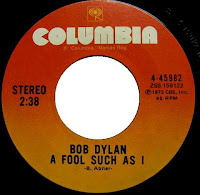 (Columbia, 1973)
A Self-Portrait outtake on the A and a New Morning outtake on the B, so you know it’s gonna be good – no shittin’! That handful of post-Blonde, pre-Geffen records might’ve peeved self-described brainiacs aplenty by refusing to offer Grand And Obscure Statements, but I prefer the entertaining cheeziness-breeziness of this stuff a lot more than I do the serious-minded hackery that makes up most of Dylan’s ’70s work. “A Fool Such as I” is funky lounge-soul that struts nimbly where similar-sounding late-period Elvis material would have lumbered, and “Lily of the West” races along on some fine guitar strummin’ and layered instrumentation. Production values rule the day: Female backing vocals! Strings! Session musicians! You betcha it’s gooey. Better believe it. AND IT WORKS! So what if both songs on here are covers? So what if they’re more about THE SONGS THEMSELVES than about DYLAN? Songs as songs, rather than missives from on-high to be ripped apart and studied. In other words: simple musical kicks. It’s a gas.
 (Columbia, 1970)
Yes, I am one of those people who unapologetically enjoys the much-hated Self-Portrait, but I can’t and won’t engage in a passionate defense of it; I’m neither a Dylan mind-reader nor a Dylan garbage-picker, so I refuse to concern myself too much with the mobius-strip mindgames that the record might or might not play. I just like the thing… it’s a bizarro, tossed-off, living-room relaxathon that is at the same time carefully and lavishly arranged, somehow pulling off what the Beatles wanted to do with the “warts and all” Get Back concept while still retaining Let it Be’s Phil Spector overkill. A lazy musical raspberry, perhaps, but an utterly charming one. “Wigwam,” the only single lifted from the album, is a syrupy – yet evocative – brass-laden piece that features a “la-da-da-da” semi-vocal crooned in Dylan’s froggy Nashville Skyline voice. Coming across less like a pop single than a musical link track, it prefigures his soundtrack work on Pat Garrett & Billy the Kid and ably proves his aptitude for stirring schmaltz. Tear-jerk strings come to the fore on “Copper Kettle,” an old-timey booze ballad that walks a fine line between delicate and over the top; a strong vocal grounds it. Both songs rather bravely abandon any rock or progressive trappings and manage to sound – even now – oddly detached from any easily identifiable time period. While the album from which these tracks come has enough overt jokiness to make one conscious of some larger artistic artifice behind the whole thing, this single is simply a strange, compelling coupling of two examples of free-floating, era-condensing, pure American sap. If it’s a joke, it’s a good one.
 (Columbia, 1965)This is Dylan gone pop. Bye-bye to the instrumental heaviness, vocal fire, and numbing length of preceding “sell-out” single “Like a Rolling Stone,” hello to cheerful organ-burble and a deceptively soothing croon spread over a sprightly 3:50 clock-time. There’s no proper chorus here, true, but the repeating musical phrases and warm midtempo mellowness leave plenty for radio listeners to latch onto – hence its deserved top-10 charting. And yet, the lyrics manage to out-nasty even “Rolling Stone,” climaxing with the rarely-topped knife-twist punchline of “I wish that for just one time / You could stand inside my shoes / You’d know what a drag it is to see you.” Ouch! So “Positively 4th Street” is a definite success as a single, both in terms of its commercial performance and Dylan’s demonstration of his popsmanship, but as a total package it can’t quite stand up next to the better album tracks from Highway 61 Revisited and Blonde on Blonde, its comparatively squishy band performance being inferior to the lean, tough playing on those records. This is all vinegar, no piss. Now, would the song’s contemptuous words be as jarring if the music had more of that edge to it? Perhaps not. Still… while I’d never trade the dead-perfect lyrics, gimme the instro bite of “From a Buick 6” (this single’s B-side) or any of Blonde on Blonde’s ragged, uptempo rockers if I want to hear Dylan actually fronting a rock ’n’ roll group.
 (Columbia, 1968)
Like “Tabatha Twitchit,” “The Red Balloon” is a brassy, semi-psychedelic pop song that doesn’t paint a very convincing picture of the Dave Clark Five as trippy funsters, but it’s both catchy and innocent enough to earn at least tepid praise from these quarters. Clark himself takes the lead vocals on this one, and its colorful, rootin’-tootin’, singalong cheeriness will likely either charm your pants off or annoy you to no end. Fans of, say, “Yellow Submarine” oughta dig it, which I hope paints a picture of what kinda goofy fun we’re dealing with here. Now, I don’t mind “The Red Balloon” too much, but I personally prefer the comparatively gritty psych authenticity of John Fred & His Playboy Band when I’m looking to have my mind blown by some boss sounds. OR… WAIT! I can just flip this single over and listen to the shockingly fiery Creation-lite rocker “Maze of Love”! One of their rawest and best guitar songs! Wow! It’s tragically obscure, though, as it never even came out on an American album.
Which leads us to a big ol’ problem.
Thing is, the DC5 catalog was a total mess by this point. Epic had stopped releasing studio albums in the States after Everybody Knows, whereas Europe kept cranking ’em out, with collections like 5 by 5 (NOT the same record as the America LP with the same title), the dire If Somebody Loves You, and the ultra-elusive Dave Clark and Friends. There are a few cheap import compilation LPs that round up some of the better songs from this period (notably Historia de la Musica Rock and Gigantes del Pop), but it is exceedingly difficult to acquire everything the band did after 1967. To make matters even more frustrating for the present-day fan, our buddy Dave, renowned biznass man that he is, continues to delude himself as to the cash value of his group’s recordings, and so we still haven’t seen ANY of the DC5 albums committed to CD as of 2008 (word has it that he has held out for a price that he just ain’t gonna get from any label). My hope was that there’d be a catalog clean-up and comprehensive reissue campaign after “Jann” Wenner let the band into his sham Hall of Fame earlier this year, but despite some rumor-mill rumblings and a so-so iTunes collection, the record-store shelves remain unburdened by DC5 CDs. Mebbe Davey’s waiting for more group members to die off? Or perhaps he thinks it’s smart to let old age swallow up a nice chunk of his original fanbase before he allows official reissues to come out? What is he thinking at this point? Does he even CARE about his group’s legacy?? Besides losing money for himself and his pals, he’s effectively consigning his band to obscurity by letting the bulk of its catalog remain out of print and largely unavailable for decades. Honestly, the guy just needs to get it together and PUT THE MUSIC OUT THERE AGAIN. Until that in fact happens, I absolutely encourage you – yes, you! — to poke around and buy or download the nifty, carefully-assembled “Complete Collection” bootlegs, because these records, all the way back to Glad All Over, deserve better, deserve to actually be heard. And if that has to be done illegally, so be it.
 (Columbia, 1967)
Why yes, I do own a French copy of “Everybody Knows,” thanks for asking! Same old syrupy dreck on the A-side, but our Gallic friends get the pleasure of experiencing “Tabatha Twitchit” on the flip. It’s a mildly psychedelic attempt at whimsy, an idiosyncratic child’s-eye character sketch of an old lady that’s powered by jaunty horns and the sort of nursery-rhyme melody common to the era’s pop-oriented lysergic-come-latelies. A charming oddity, nothing more. Notable, though, in that neither song is instantly recognizable as the Dave Clark Five, so have fun confounding your friends with this one.
 (Columbia, 1967)
You might think it’s silly and confusing to issue two different singles called “Everybody Knows” over the course of your career, but Dr. David Clark and his merry foursome happens to disagree. And so we have the release of “Everybody Knows (We’re Through)” a mere three years after “Everybody Knows (I Still Love You)”. While the songs actually have little in common beyond their titles, I do appreciate the false sense of sequel that the parentheticals lend the proceedings… of course, if one really wants to, it can be imagined that the slow, sappy defeatism of the later song is the sound of the lovelorn narrator of the upbeat original, now older and wiser, simply giving up. It’s a treacly bit of heavily-orchestrated melodrama that prefigures fat Elvis, minus the cheap button-pushing dynamism that makes Presley’s bloated hits guilty pleasures. A failure. Things do go better on the B-side, as the thumping garage soul of “Concentration Baby” – with an urgent keyboard part that’s awfully reminiscent of “You Keep Me Hangin’ On” – plays well to the Dave Clark Five’s strengths as an energetic rock ’n’ roll band and shows that the group was making at least tentative steps towards changing with the times. [This is the Danish version of the single; in America, “Inside and Out” appeared as the B.]
 (Columbia, 1980)


